The Feedback Loop Rewired: AI Across the Full Delivery Lifecycle
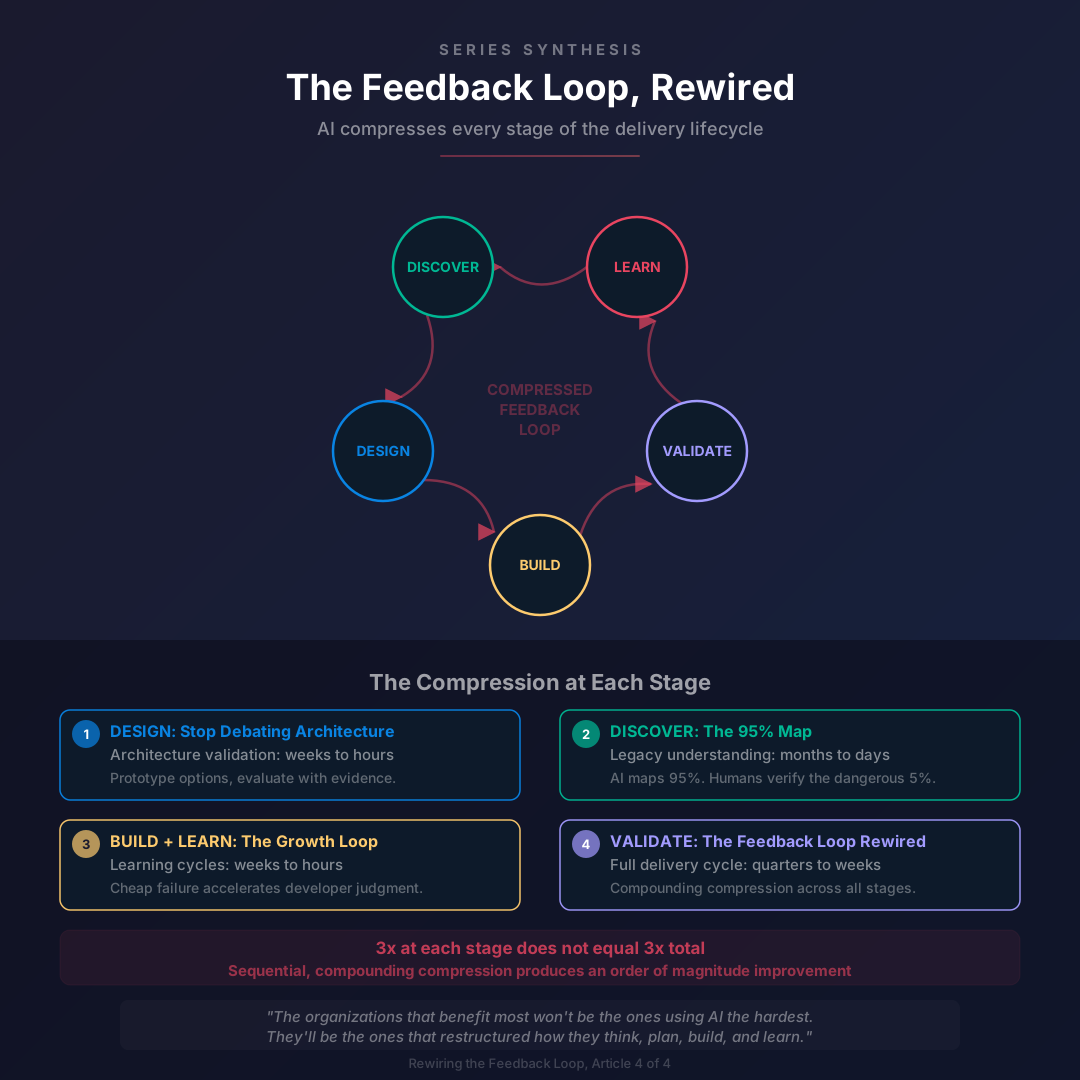
Over the past three articles, I’ve been making a single argument from three different angles: AI compresses feedback loops. Not in the vague “AI makes everything faster” sense that you hear in vendor pitches. In the specific, measurable, operationally significant sense that the time between “we think this is right” and “now we know whether it’s right” has shrunk dramatically at every stage of software delivery.
In architecture, the loop between proposing an approach and validating it against reality went from weeks to hours. In legacy modernization, the loop between “we don’t understand this system” and “we have a working model of what it does” collapsed from months to days. In developer growth, the loop between “try an approach” and “learn from the result” compressed from weeks to hours.
Each of those compressions is valuable on its own. The compounding effect is what changes how organizations deliver software.
The compounding effect
Think about a typical feature delivery. Before any code gets written, someone needs to understand the existing system well enough to know where the new feature fits. Then someone needs to make architecture decisions about how to implement it. Then the team builds it. Then they validate it works. Then, ideally, the developers involved learn something from the process that makes them better at the next one.
That’s the delivery loop: discover, design, build, validate, learn. It’s always been a loop. The question is how long one rotation takes.
In the pre-AI world, each stage had its own bottleneck. Discovery was slow because understanding existing systems required reading code manually. Design was slow because you couldn’t afford to prototype multiple options. Building was… actually building was always the part that went fastest relative to the other stages. Validation was slow because testing was manual or the test infrastructure was inadequate. Learning was slow because failure was expensive, so people failed rarely, so judgment accumulated slowly.
AI compresses every stage. And because they’re sequential and compounding, a 3x improvement at each stage doesn’t produce a 3x improvement in total cycle time. It produces something closer to an order of magnitude.
A feature that used to take a quarter from concept to production might take a month. A modernization initiative that used to take a year might take a quarter. Not because anyone is working harder or longer hours. Because the dead time between stages, the waiting, the uncertainty, the rework that comes from discovering problems late, all of it shrinks.
The organizational mismatch
Here’s the problem: most organizations are still structured around the old cycle times.
Planning happens in quarterly increments because that’s how long it used to take to deliver meaningful change. Architecture review boards meet monthly because that used to be a reasonable cadence for the volume of decisions. Hiring pipelines assume junior developers need two to three years to become productive mid-level contributors because that’s how long it used to take to accumulate enough learning cycles.
When the cycle times compress, these structures become bottlenecks. Your team can prototype three architecture options in a day, but the review board doesn’t meet until next Thursday. Your developers can discover and map a legacy system in a week, but the project plan allocated six weeks and the downstream milestones don’t shift. Your junior developer is growing at twice the historical rate, but the promotion cycle is still annual.
The technology change is the easy part. The organizational change is where teams actually get stuck.
What restructuring looks like
I’m not going to pretend there’s a universal playbook for this, because every organization is different. But I’ve seen patterns that work across the teams I’ve consulted with, and they share common characteristics.
None of them happened quickly. I’ve watched teams take the better part of a year to shift a single review cadence, and every change required political capital from engineering leadership. The patterns below are what worked, but they’re measured in quarters, not sprints.
Decision cadence matches capability cadence. If your team can produce evaluated prototypes in a day, your architecture review process should be able to consume them in a day. That doesn’t mean you skip rigor. It means you don’t let process latency waste the speed you’ve gained. Some teams do this by replacing scheduled review meetings with asynchronous review workflows where a senior engineer can evaluate and approve a prototype within hours of it being produced.
Planning horizons shrink. Quarterly planning made sense when you could barely deliver one significant thing per quarter. When delivery accelerates, planning needs to accelerate too. The teams I’ve seen handle this best moved to shorter planning cycles (six weeks or even two-week iterations of meaningful scope) with a lightweight quarterly vision that sets direction without over-specifying deliverables.
Verification gets promoted to a first-class activity. When you can build faster, the temptation is to build more. The disciplined teams resist this and invest the time savings into more thorough verification: shadow production for legacy replacements, automated comparison testing, extended canary periods. Building faster means nothing if you’re shipping bugs faster too.
Growth expectations adjust. If your junior developers are accumulating learning cycles at three to five times the historical rate, your expectations for their growth trajectory should reflect that. This means faster progression for people who are demonstrably growing, more challenging assignments earlier in their tenure, and mentorship that’s calibrated to accelerated learning rather than traditional timelines.
The “just use AI harder” trap
I want to name a failure mode I’ve seen repeatedly, because it’s seductive and counterproductive.
Some organizations respond to AI capabilities by trying to maximize raw output. More features per sprint. More code per developer. More projects running in parallel. They treat AI as a multiplier on volume and measure success by throughput.
This misses the entire point. The value of compressed feedback loops isn’t that you can do more things. It’s that you can learn faster whether the things you’re doing are right. If you use the compression to do 5x the work without 5x the verification, you’re just generating technical debt at a higher rate.
The organizations that get this right use AI compression to shift effort from production to evaluation. They don’t build five features in the time it used to take to build one. They build one feature, with more thorough discovery, more explored design options, more rigorous validation, and more deliberate learning extraction. The feature is better, the team is better, and the organization actually moves faster over time because it’s accumulating less rework.
Velocity without direction is just expensive wandering.
The human layer
Through all four articles in this series, there’s been a consistent thread: AI compresses the mechanical work, which makes the human judgment work more important and more visible.
In architecture, the human’s job shifts from proposing solutions to evaluating them. In legacy discovery, the human’s job shifts from reading code to identifying what the code can’t tell you. In developer growth, the senior’s job shifts from gatekeeping decisions to extracting learning from exploration. In every case, the human role becomes more about judgment and less about labor.
This is good news if you’re someone who has good judgment, or if your organization knows how to develop it. It’s challenging news if your organization has been hiding judgment deficits behind process and bureaucracy, because those shields don’t work when everything moves faster.
The teams I worry about are the ones where “senior” means “has been here a long time” rather than “has good engineering judgment.” When the feedback loop compresses, the gap between those two definitions becomes painfully visible. People with genuine expertise get more valuable. People with only tenure get exposed.
What to do Monday morning
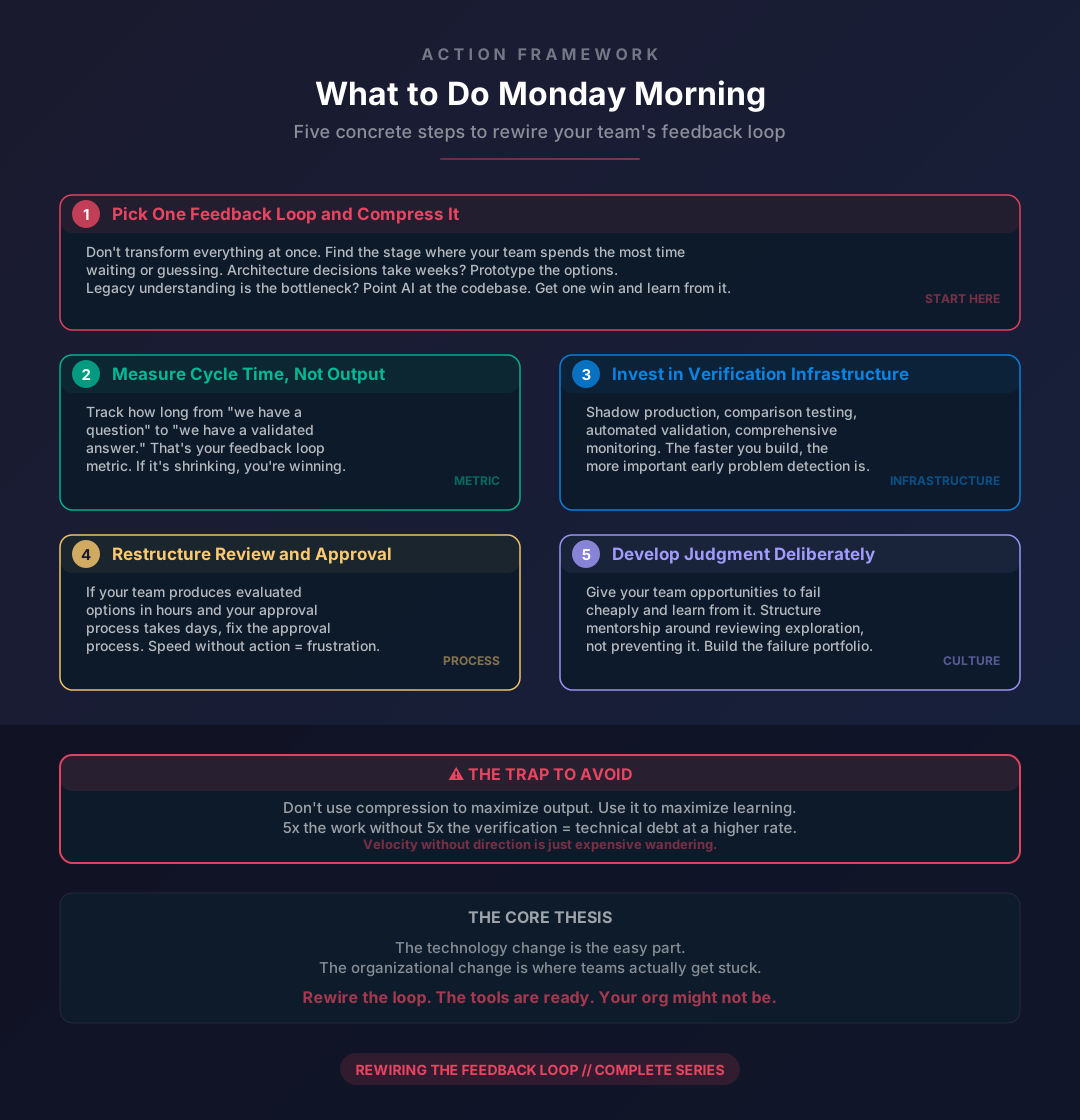
If you’ve read this far and you’re thinking about what this means for your team, here’s where I’d start:
Pick one feedback loop and compress it. Don’t try to transform everything at once. Pick the stage where your team spends the most time waiting or guessing. If architecture decisions take weeks, start prototyping options. On a recent engagement, we compressed a months-long architecture evaluation into a week by walking in with a working prototype validated against production data. If legacy understanding is the bottleneck, point AI at your codebase and verify the output. If junior developer growth is too slow, structure exploration time with review. Get one win and learn from it.
Measure cycle time, not output. Track how long it takes to go from “we have a question” to “we have a validated answer.” That’s your feedback loop metric. If it’s shrinking, you’re on the right path. If it’s not, you’re probably applying AI to the wrong stage or your organizational structure is absorbing the time savings.
Invest in verification infrastructure. Shadow production, comparison testing, automated validation, comprehensive monitoring. I described in an earlier article how a perfectly working dev prototype can hide production failures that simply don’t exist in your test environment. The faster you build, the more important it is to catch those gaps early. This is not the place to cut corners.
Restructure your review and approval processes. If your team can produce evaluated options in hours and your approval process takes days, fix the approval process. Speed without the ability to act on it is just frustration.
Develop judgment deliberately. Give your team opportunities to fail cheaply and learn from the failures. Structure mentorship around reviewing exploration, not preventing it. When a junior developer arrives with three approaches they’ve already tried and can articulate why two didn’t work, the senior conversation becomes about extracting principles, not dispensing solutions. Build the failure portfolio culture I described in the previous article.
The feedback loop, rewired
The title of this series is deliberate. Rewiring implies intention. The feedback loop is compressing whether you do anything about it or not. AI tools are already available, and your competitors are already using them.
The question isn’t whether to adopt AI. It’s whether you’ll restructure your organization to actually benefit from what AI makes possible. The tools are the easy part. The thinking, the planning, the building, the learning: those are the parts that matter. They always have been.
The organizations that benefit most from compressed feedback loops won’t be the ones using AI the hardest. They’ll be the ones that restructured how they think, plan, build, and learn around that compression.
That’s the feedback loop, rewired.
This is the final article in the “Rewiring the Feedback Loop” series on how AI compresses feedback loops across software delivery.
Related Articles
AI Coding Tools: A Seasoned Technologist's Strategic Advantage
AI coding assistants boost productivity by 55%, but experienced architects get more value using AI as a virtual junior team for routine tasks.
The Artisan's Dilemma: Balancing Craftsmanship and Pragmatism in the Digital Forge
Real-world case studies in serverless architecture and Prime Video's infrastructure shift reveal when craftsmanship matters — and when pragmatism wins.