The 95% Map: How AI Discovers Your Legacy System (and Why the Last 5% Can Wreck You)
I once spent six weeks reverse-engineering a payment processing system that nobody on the team had built. The original developers were gone. The documentation was three years stale. The code had the kind of naming conventions that suggested someone had been angry when they wrote it. We needed to understand it well enough to replace it, and the only way forward was reading every line, tracing every call path, and interviewing the operations team about the behaviors they’d observed over the years.
Six weeks. Four people. And we still missed things.
That kind of discovery work, the slow archaeology of understanding what a system actually does versus what anyone thinks it does, has always been the bottleneck in modernization projects. Not the building. The understanding. You can’t replace what you don’t understand, and the understanding has always been brutally expensive to acquire.
That cost just collapsed.
AI does archaeological digs in hours
The sheer mechanical work of reading code, tracing dependencies, mapping data flows, cataloguing API surfaces, identifying dead code, and building a mental model of how a system is wired together: AI is extraordinarily good at this. Not because it understands the system in any meaningful sense, but because it can process volume that humans simply can’t match.
Point a capable model at a legacy codebase and ask it to produce a dependency graph, a list of external integrations, a summary of each module’s responsibilities, and a catalogue of the implicit contracts between components. What used to take a team weeks of painful reading now takes hours of guided prompting. The output isn’t perfect, but it’s a vastly better starting point than a blank whiteboard. (This does assume your AI tooling has appropriate access to the codebase, which in regulated industries means self-hosted models or enterprise tools with proper data governance. That’s table stakes for most orgs by 2026, but it’s worth naming.)
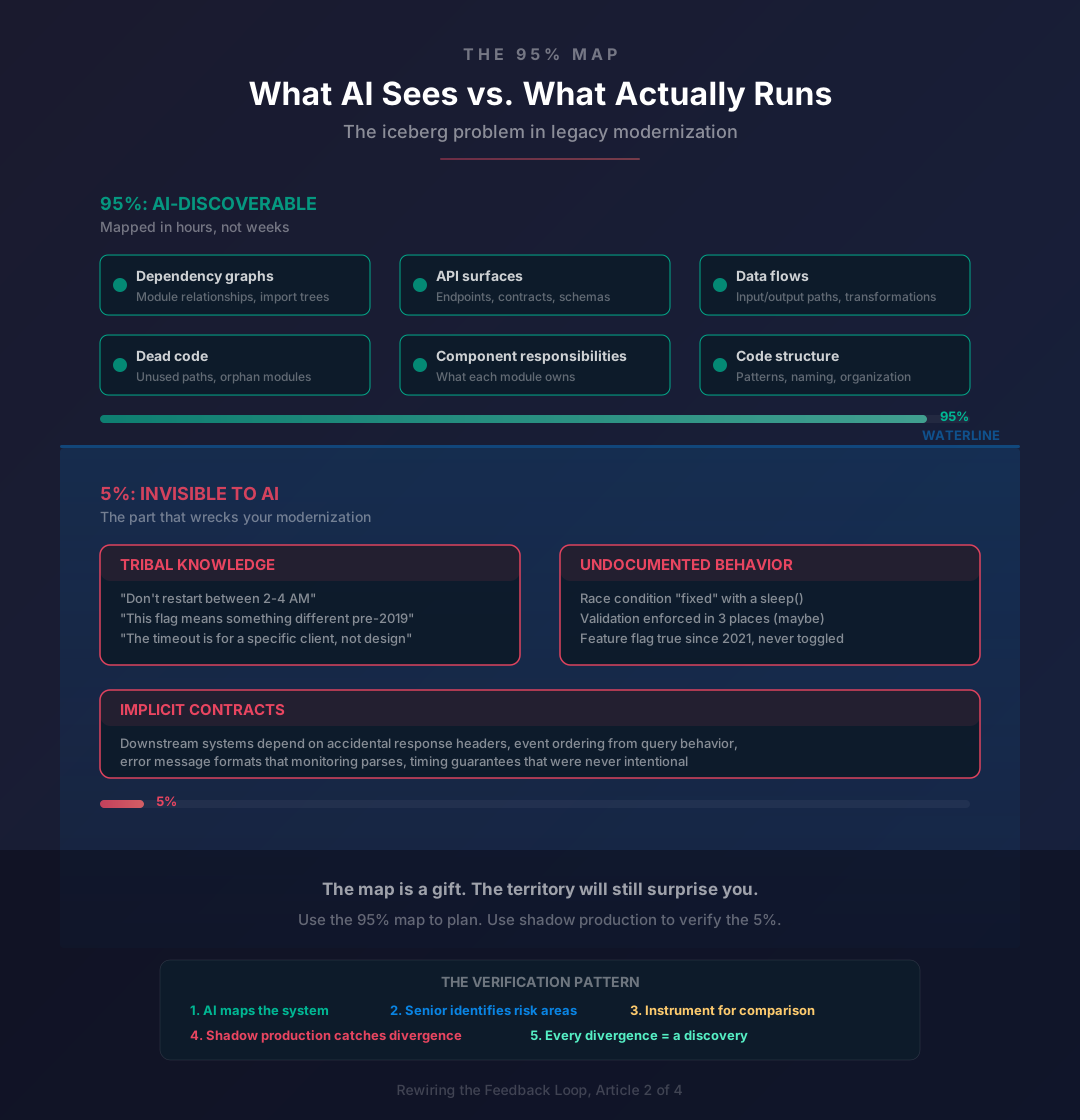
This is the “95% map.” The structural understanding. What calls what, what data flows where, what the system’s shape looks like from above. AI can build this map faster than any human team, and the map is usually accurate enough to plan around.
Here’s where teams get into trouble: they mistake the map for the territory.
The Ship of Theseus problem
Every long-running system has a version of this story. The original design made sense. Then requirements changed, and someone patched it. Then the patch had an edge case, and someone patched the patch. Then a performance problem showed up, and someone added a cache that subtly changed the ordering guarantees. Then someone else built a downstream system that depended on that accidental ordering.
After enough of these cycles, the system you’re looking at isn’t the system anyone designed. It’s the Ship of Theseus: every plank has been replaced, and the thing that’s running in production doesn’t match any single person’s mental model. The code says one thing. The runtime behavior says something slightly different. The operational reality says something different still.
AI reads the code. It doesn’t know about the runtime behavior. It doesn’t know about the operational reality. And it definitely doesn’t know about the conversation that happened two years ago where the ops team said “don’t ever restart this service between 2 and 4 AM because that’s when the batch job from the finance system hits the shared database.”
That conversation is nowhere in the codebase. It’s in someone’s head. Maybe it’s in a Slack thread that nobody can find. Maybe it’s in a runbook that refers to a service by its old name. This is the 5%.
The dangerous 5%
The 5% that AI misses is not a random sample of the system. It’s the most dangerous part. It’s the part that only exists as tribal knowledge, undocumented behavior, and implicit contracts. Specifically:
Tribal knowledge. The team knows that this endpoint has a 30-second timeout because of a specific client integration, not because of any architectural decision. The team knows that this flag in the database means something different for records created before 2019. The team knows that the retry logic was configured to handle a specific failure mode in a third-party API that might or might not still exist.
Undocumented behavior. The system does things that aren’t in any specification because they emerged from the interaction of components over time. A race condition that was “fixed” by adding a sleep statement. A validation rule that’s enforced in three different places because nobody was sure which one was actually running. A feature flag that’s been set to true in production for so long that nobody knows what happens when it’s false.
Implicit contracts. Downstream systems depend on behaviors that were never intentional. The response always includes a header that some consumer parses. The events are always emitted in a specific order because of how the database query happens to work. The error messages follow a format that another team’s monitoring is built to parse.
AI can’t find these because they don’t exist in the code. They exist in the gap between what the code says and what the system does.
Environment gaps. The 5% can also hide in plain sight. Dev doesn’t reflect prod, and correct-looking code can’t surface the difference.
I hit this one recently on a core business system. Mathematically deterministic, deeply entangled in a distributed monolith. Working alongside a developer who’d been on the system for several years, I was tracing a code path and found a call to an external system. I couldn’t find a logical justification for it. Neither could the AI. The main database had all the data we needed. The external call was returning empty in dev. Tests passed without it. The modernized version worked cleanly end to end.
The natural conclusion was dead code. A redundant integration from some earlier design that nobody had cleaned up.
It wasn’t. The external system handled pending transactions. The main database only contained committed transactions. In production, a batch job pulled pending data from that external system via CSV to bridge the gap. The integration existed because of a real production constraint that simply didn’t exist in the dev environment.
Here’s what made this instructive: it wasn’t obscure tribal knowledge held by one person. Most of the team probably knew about it. But I’m a principal-level architect with AI assistance, and I built a working prototype that looked perfect in dev without it. Tests passed. Logic was clean. Penny-for-penny validation against test data looked correct. And it would have gone to production wrong.
The 5% takes all of these forms, and often several at once. Tribal knowledge, undocumented behavior, implicit contracts, environment parity gaps. The common thread is that none of them live in the code. The AI reads the code accurately. The code tells the truth about what it does in the environment where you’re testing. And sometimes that truth is incomplete.
Shadow production: trust but verify
This is why I’m a strong advocate for running both systems in parallel. Dev validation is necessary, but it’s not sufficient when the environment itself can’t reproduce every production condition.
The teams that handle this well don’t skip the AI-generated map. They use it, and then they verify it against reality. The best technique I’ve seen is what I call “shadow production”: running the new system alongside the old one and comparing their behavior on real traffic.
This isn’t a new idea. It’s the strangler fig pattern, canary deployments, traffic mirroring. What’s different is that AI compresses the timeline to the point where you can actually afford to do this rigorously. When the discovery phase that used to take six weeks now takes a few days, you can invest the time you saved into a longer, more thorough verification period.
The pattern looks like this: AI generates the map. A senior engineer reviews the map and identifies the areas of highest risk, the parts where tribal knowledge is most likely to lurk. The team instruments those areas with detailed logging and comparison tooling. They run shadow traffic through both systems and watch for divergence.
Every divergence is a discovery. It’s the system telling you about something the code didn’t. Each one is a learning cycle — the same kind of cheap failure that accelerates developer growth.
The senior engineer’s new job
This is where the human role shifts dramatically. The senior engineer’s value in a legacy modernization used to be their ability to read code faster and hold more of the system in their head. Now that AI handles the volume, the senior engineer’s value is their ability to identify what’s not in the code.
They’re the ones who know to ask: “What happens during the monthly close process?” and “Is there a reason this column has two different date formats?” and “Who is the person who’s been here longest and knows where the bodies are buried?”
These are not questions AI can generate from reading the codebase. They come from experience with how organizations actually work, from pattern recognition about where undocumented behavior tends to hide, from knowing that the real system is always more complicated than the code suggests. It’s the kind of pragmatic judgment that separates craft from recklessness.
The senior engineer stops being the person who reads the most code and becomes the person who asks the questions the code can’t answer. That’s a better use of a $200K+ salary, frankly.
The modernization playbook, compressed
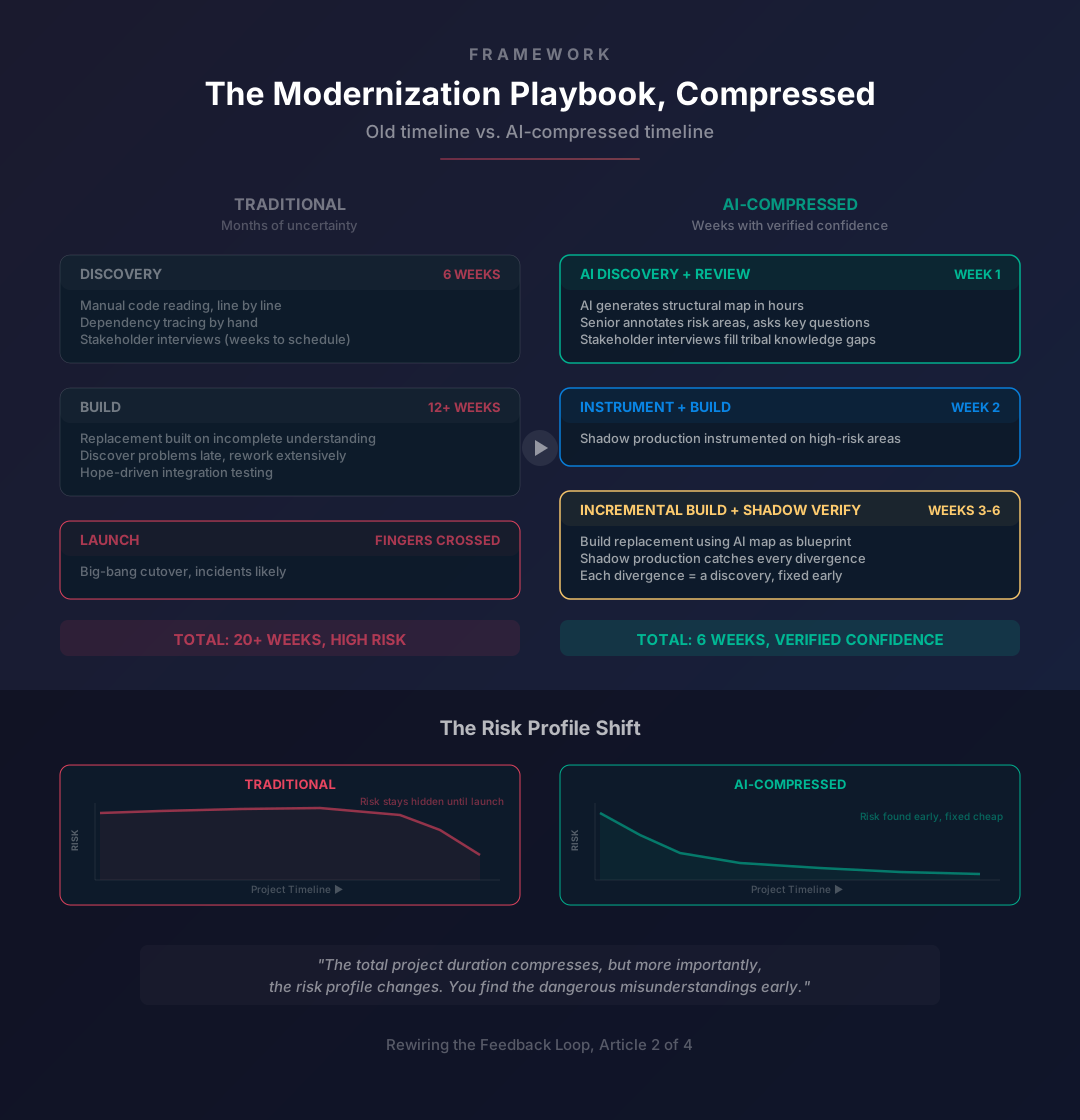
Here’s what this looks like end to end:
Week 1. AI generates the structural map: dependencies, data flows, API surfaces, dead code, component responsibilities. A senior engineer reviews and annotates with risk areas and questions the code can’t answer.
Week 2. The team interviews stakeholders and operations to fill in tribal knowledge gaps. They instrument high-risk areas for shadow comparison.
Weeks 3-6. Build the replacement incrementally, using the AI map as the blueprint and shadow production as the verification layer. Every divergence between old and new behavior is investigated, classified, and resolved.
Compare that to the old timeline: weeks 1 through 6 just for discovery, followed by months of building with fingers crossed. The total project duration compresses, but more importantly, the risk profile changes. You’re finding the dangerous misunderstandings early, when they’re cheap to fix, instead of late, when they’re expensive.
Knowing what you don’t know
The core insight is counterintuitive: AI makes the easy part of legacy discovery nearly instant, which means you can finally afford to spend real time on the hard part. The 95% map is genuinely valuable. It’s a starting point that would have been unthinkable five years ago. But it’s a starting point, not an answer.
The teams that will succeed at modernization aren’t the ones that generate the most comprehensive AI analysis. They’re the ones that understand what AI analysis can’t tell them and have a systematic approach to finding out.
The 95% map is a gift. The 5% it misses will wreck you if you don’t go looking for it.
This is the second article in the “Rewiring the Feedback Loop” series on how AI compresses feedback loops across software delivery.
Related Articles
AI Coding Tools: A Seasoned Technologist's Strategic Advantage
AI coding assistants boost productivity by 55%, but experienced architects get more value using AI as a virtual junior team for routine tasks.
The Artisan's Dilemma: Balancing Craftsmanship and Pragmatism in the Digital Forge
Real-world case studies in serverless architecture and Prime Video's infrastructure shift reveal when craftsmanship matters — and when pragmatism wins.